Vultra is a collection of graphics and engine projects that I maintain for research and game development. Current libvultra work takes place on dev-VRI. dev-next was an experiment, and its prototypes are separate from the current development branch.
Origins
The work grew out of Snow Leopard Engine, an OpenGL group project from my MSc at Leeds, and the rendering tools I later needed for my PhD. I split reusable components into separate repositories so they could also be used by small applications and research prototypes.
Design Principles
- Explicit rendering APIs and readable C++ / Slang code.
- Optional capabilities: a direct GPU program should not need an editor, ECS, importer or scripting host.
- Reusable tools and libraries with clear ownership.
- Offline asset and shader processing where it is useful, alongside runtime inspection and experiments.
Why Not an Existing Solution?
I wanted a framework suited to my own graphics and VR experiments: explicit resource and synchronization control, portable shaders, OpenXR support, and small examples that can be read and changed directly. These requirements led to VRI and the related libraries.
Architecture
The current libvultra branch uses VRI directly. VRI-Framework is a separate reusable library over the same RHI; it is not an intermediate dependency required by libvultra.
flowchart TB
    VRI["VRI · render hardware interface"] --> libvultra["libvultra · dev-VRI"]
    VRI --> VRF["VRI-Framework · reusable capabilities"]
    VRI --> Lazy["Lazy-100 · fantasy console"]
    vtask["vtask · task scheduling"] --> libvultra
The shader, asset, filesystem and JSON render-graph projects below are standalone parts of the wider ecosystem. Their presence here does not imply that every one is a dependency of the current engine branch.
libvultra — Graphics Framework
| Branch | Role |
|---|---|
dev-VRI |
Current development: a C++23 graphics framework built directly on VRI. |
dev-next |
Experimental engine architecture and prototypes. |
master |
Earlier Vulkan-based implementation, with its own examples and documentation. |
The current development branch targets Windows x64 and Linux x86_64 with Vulkan. It includes explicit RenderGraph construction in C++ and JSON, Slang compilation and reload, scene import, raster rendering, offline experiments and a research workbench. Editor interfaces, native/Lua/C# scripting and XR examples are optional capabilities.
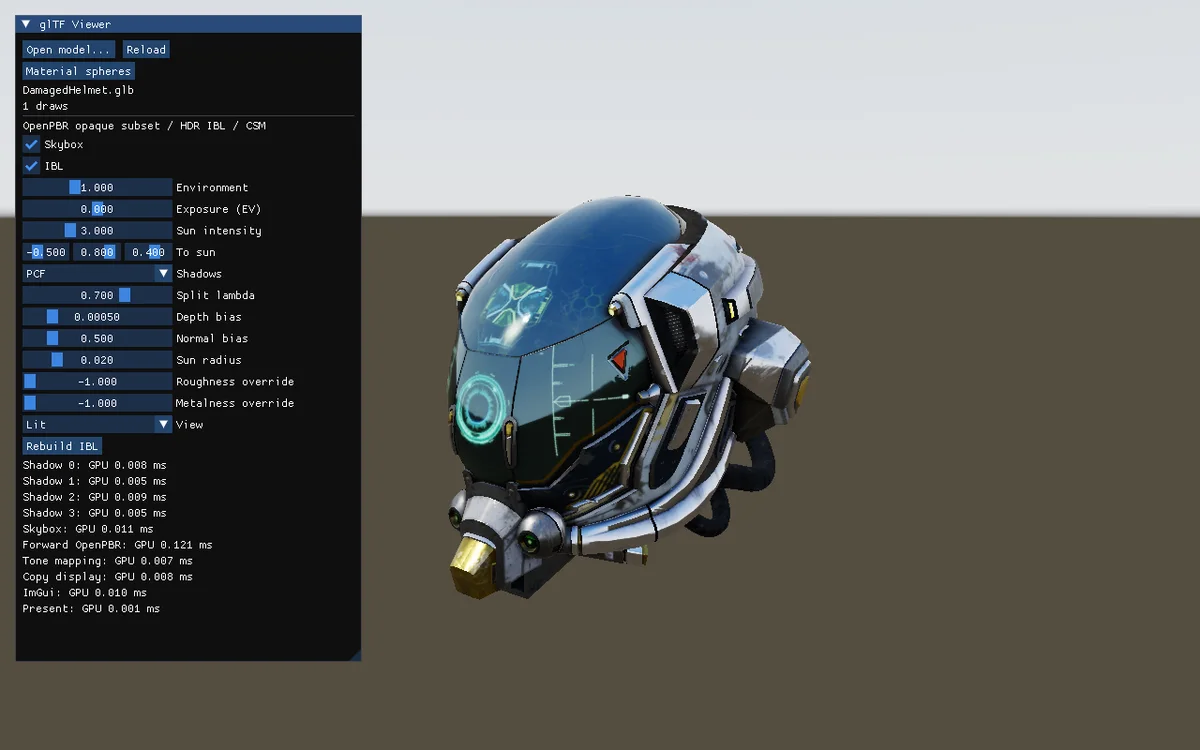
This is early development. Static geometry and an opaque OpenPBR material subset are the current documented scope. Broader backend support, gameplay authoring and delivery work should be read against the branch’s roadmap, rather than inferred from the RHI’s capabilities.
Earlier libvultra examples remain available. The screenshot above is from the current branch’s glTF viewer; its sample assets retain the attribution recorded in that repository.
VRI — Render Hardware Interface
VRI project page · Source · Browser examples
VRI provides an explicit rendering API through a C ABI and a C++23 wrapper. Backends cover Vulkan, D3D12, Metal, WebGPU and OpenGL-family APIs. Optional features are reported through capabilities; support varies by backend. Software Vulkan implementations support headless and GPU-less use.
VRI’s backend coverage is broader than the current libvultra branch’s supported target set. Lazy-100 is another application built on VRI.
VRI-Framework — Reusable Rendering Capabilities
VRI-Framework project page · Public repository
VRI-Framework supplies C++23 building blocks including RAII resources, presentation, a framegraph, GPU profiling, multi-queue submission and OpenXR lifecycle helpers. Applications compose these into their own renderer. The library has an example application loop and a host-driven render module.
It remains a separate project. Current libvultra dev-VRI uses VRI directly and acknowledges specific VRI-Framework asset conventions in its own documentation.
vshadersystem — Shader Compilation
The standalone Slang pipeline adds material reflection, keyword variants and precompiled shader libraries. Version 1.0 replaced the old INI-style GLSL DSL. Slang emits SPIR-V and WGSL directly; runtime consumers load the compiled files without a Slang dependency.
vasset — Asset Pipeline
vasset imports meshes, textures and materials into engine formats, tracks assets with UUIDs and packages them into VPK archives. It includes a desktop CLI, virtual-filesystem integration and a WebAssembly import example.
vrendergraph — JSON Pipeline Descriptions
A standalone JSON render-pipeline schema and runtime builder, including resource descriptions, passes and optional editor metadata. It was used in the earlier data-driven pipeline experiments. Current dev-VRI documents its own RenderGraph interfaces and JSON construction separately.
webgpu-sdk — WebGPU Build and Distribution
A reusable C/C++ SDK bundle for desktop and WebAssembly consumers. It packages third-party WebGPU implementations and build dependencies, including wgpu-native, Dawn and Emscripten integrations, with glfw3webgpu as a separate helper target. The repository provides platform build and prebuilt-release workflows, and credits WebGPU-distribution as an upstream influence.
Its role is dependency packaging and build integration. The WebGPU implementations remain those of the bundled upstream projects.
vbase — Foundation Utilities
Shared utilities include IDs, result/error types, binary readers and writers, module and service registries, signals and events. The library is intended for reuse outside a single engine.
vfilesystem — Filesystem Abstraction
Filesystem interfaces, normalized paths, physical and memory backends, and a virtual-filesystem mount table. Higher-level asset loading and VPK packaging live in vasset.
The library is built on vbase and leaves synchronization to the host application. It does not provide asynchronous IO or task scheduling; its README documents these boundaries and platform-specific asset/writable filesystem handling.
vtask — Task Scheduling
A work-in-progress task-management library built on enkiTS. The current libvultra development branch uses it for parallel loading and import jobs. enkiTS supplies the underlying scheduler; vtask provides the ecosystem’s task-management layer.
Where It’s Going
My current work is on the dev-VRI graphics framework and research workflow. The branch’s examples and roadmap are the reference for what is implemented, experimental or still planned.