This post was translated from the original with AI assistance. Read the original
Next, let’s analyze the role CMake plays in the Pilot engine.
The Role of CMake in Pilot (Part 1)#
Why did it take me so long to post this? Because Pilot has been updated pretty frequently lately, and the original CMakeLists.txt was too convoluted and not very intuitive. After many revisions, the current CMakeLists.txt is now very simple and intuitive, so let’s start analyzing it!
Pilot version used while writing this post: https://github.com/BoomingTech/Pilot/commit/83db9024c13a1882f95370d87ddda0a6063b643a
What Is CMake?#
You’ve probably heard of make and Makefiles to some extent. A Makefile can describe the compiler used for the build, the libraries to link, the linking rules, compile flags, build dependency rules, and so on. The make program then runs commands according to the Makefile’s description to carry out the build.
CMake, on the other hand, generates project files based on what’s described in CMakeLists.txt, including but not limited to Visual Studio project files, Ninja project files, Unix Makefiles project files, MinGW Makefiles project files, and so on. Which kind of project file it generates can be specified with a command-line argument (-G), i.e. specifying the Generator CMake uses:
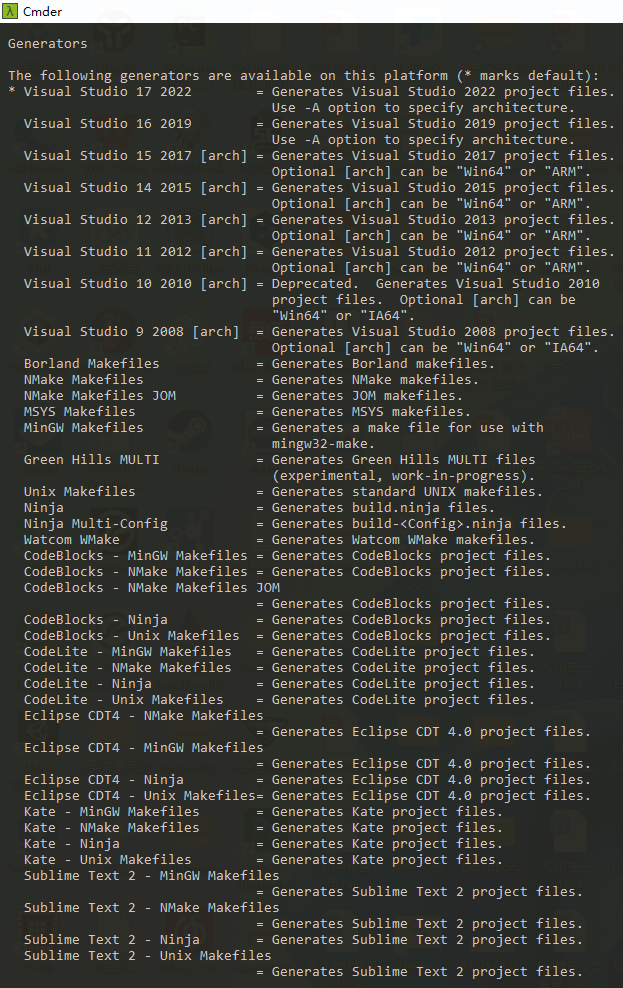
In other words, CMake is really a
Line-by-Line Analysis of Pilot’s Root CMakeLists.txt#
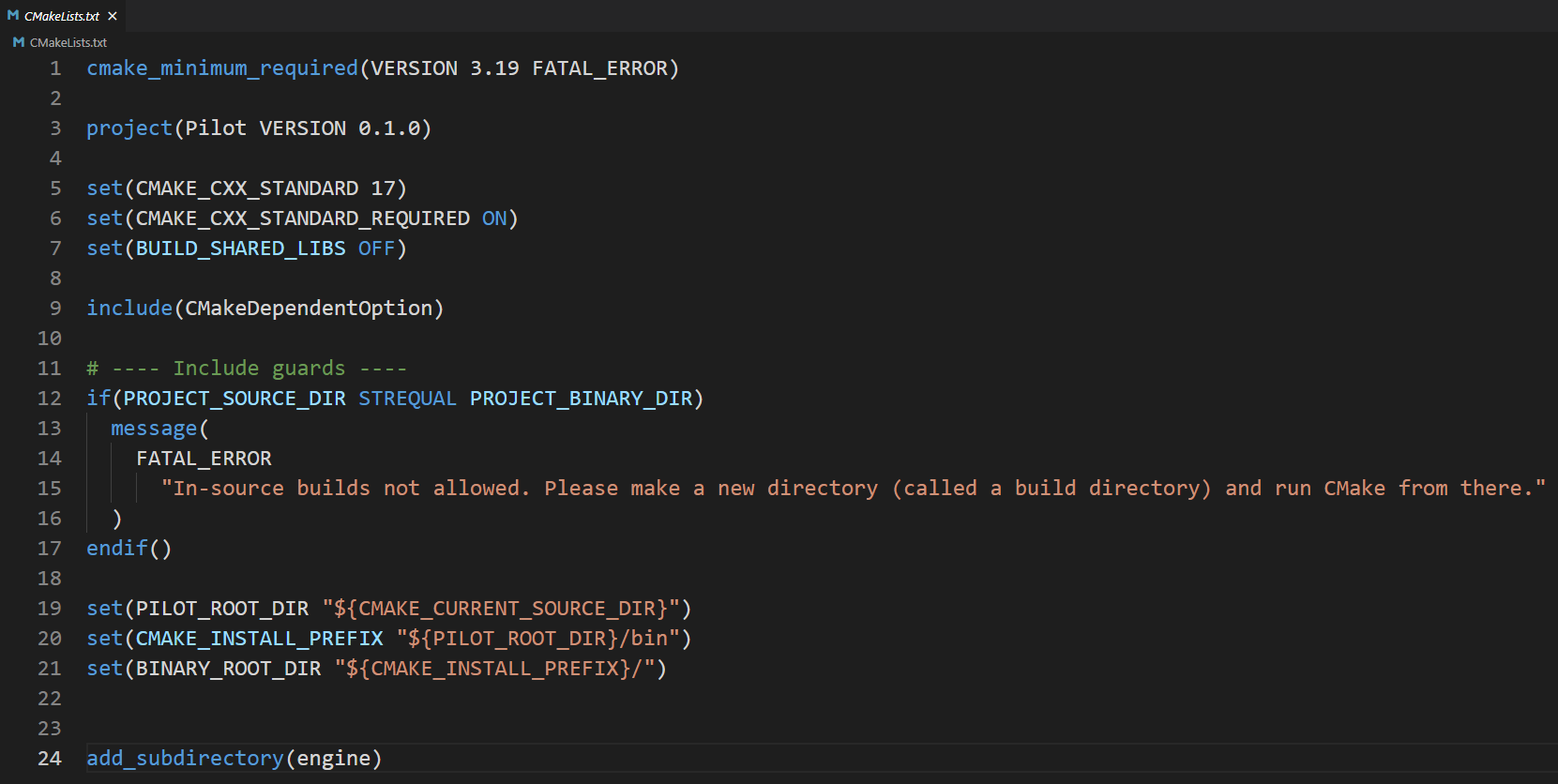
The parts highlighted in blue are called CMake commands, and what’s inside the parentheses are the command arguments. Let’s go through the meaning of each command and its arguments one by one.
cmake_minimum_required(VERSION 3.19 FATAL_ERROR)This line means: the minimum required cmake version at runtime is 3.19, otherwise an error is raised. For more on the cmake_minimum_required command, click here
project(Pilot VERSION 0.1.0)This line means: the project name is Pilot and the version is 0.1.0. For more on the project command, click here
set(CMAKE_CXX_STANDARD 17)This line means: the project uses the C++17 standard.
The set command sets variables (including normal variables, cache variables and environment variables), and CMAKE_CXX_STANDARD is a built-in CMake variable. For more on the set command, click here
set(CMAKE_CXX_STANDARD_REQUIRED ON)This line means: the project requires the specified C++ standard.
set(BUILD_SHARED_LIBS OFF)This line means: set the BUILD_SHARED_LIBS variable to OFF. This isn’t a built-in CMake variable, so it’s a variable needed by the CMakeLists.txt in a CMake subdirectory; more on that later.
include(CMakeDependentOption)This line means: include CMake’s built-in cmake_dependent_option function, which will be used later. Click here to learn more
# ---- Include guards ----
if(PROJECT_SOURCE_DIR STREQUAL PROJECT_BINARY_DIR)
  message(
    FATAL_ERROR
      "In-source builds not allowed. Please make a new directory (called a build directory) and run CMake from there."
  )
endif()
This block means: if the project’s source directory and binary directory are the same (the strings are equal), emit an error message telling you in-source builds aren’t allowed, and that you need to create a new folder, e.g. a build folder, and run cmake from inside it. Note that in CMake, every if must be matched by an endif — what’s opened must be closed. STREQUAL compares whether the strings on both sides are equal.
set(PILOT_ROOT_DIR "${CMAKE_CURRENT_SOURCE_DIR}")This line means: set the value of PILOT_ROOT_DIR to the value of CMAKE_CURRENT_SOURCE_DIR. ${variable name} gets a variable’s value. CMAKE_CURRENT_SOURCE_DIR is a built-in CMake variable referring to the directory containing the current CMakeLists.txt, so this sets Pilot’s root directory to the directory of the current CMakeLists.txt.
set(CMAKE_INSTALL_PREFIX "${PILOT_ROOT_DIR}/bin")This line means: set the value of CMAKE_INSTALL_PREFIX to the bin directory under the current root directory. CMAKE_INSTALL_PREFIX is a built-in CMake variable for the project’s install path prefix, i.e. where the final binaries get installed; here it’s set to the bin directory under Pilot’s root.
set(BINARY_ROOT_DIR "${CMAKE_INSTALL_PREFIX}/")This line means: set the value of BINARY_ROOT_DIR to the value of CMAKE_INSTALL_PREFIX plus a path separator. Effectively, this sets the binaries’ root directory to the directory of the install path prefix, which by default is the bin directory under Pilot’s root.
add_subdirectory(engine)This line means: add a subdirectory named engine. Note that cmake will go into the added subdirectory (here, engine), look for a CMakeLists.txt there, and run it. So next we’ll analyze the CMakeLists.txt in the engine directory.
Line-by-Line Analysis of the engine Directory’s CMakeLists.txt#
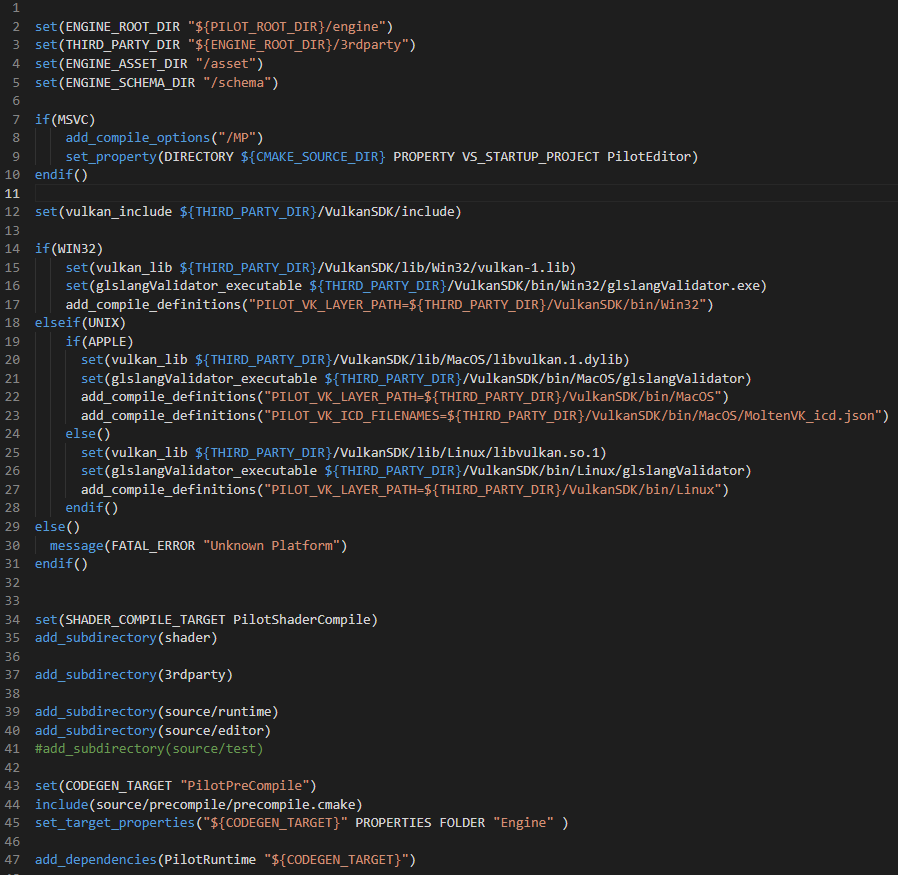
set(ENGINE_ROOT_DIR "${PILOT_ROOT_DIR}/engine")This line means: set the value of ENGINE_ROOT_DIR to the value of PILOT_ROOT_DIR plus /engine. Effectively, this sets the
set(THIRD_PARTY_DIR "${ENGINE_ROOT_DIR}/3rdparty")This line means: set the value of THIRD_PARTY_DIR to the value of ENGINE_ROOT_DIR plus /3rdparty. Effectively, this sets the
set(ENGINE_ASSET_DIR "/asset")This line means: set the value of ENGINE_ASSET_DIR to the relative path /asset. Actually, I think that for consistency this line should be changed to: set(ENGINE_ASSET_DIR "${ENGINE_ROOT_DIR}/asset"). Effectively, this sets the
set(ENGINE_SCHEMA_DIR "/schema")This line means: set the value of ENGINE_SCHEMA_DIR to the relative path /schema. Actually, I think that for consistency this line should be changed to: set(ENGINE_SCHEMA_DIR"${ENGINE_ROOT_DIR}/schema"). Effectively, this sets the
if(MSVC)
    add_compile_options("/MP")
    set_property(DIRECTORY ${CMAKE_SOURCE_DIR} PROPERTY VS_STARTUP_PROJECT PilotEditor)
endif()
This block means: if Microsoft’s MSVC compiler is used (building with Visual Studio), add the compile option /MP and set the VS startup project to PilotEditor. /MP means build with multiple processes. Click here to learn more
set(vulkan_include ${THIRD_PARTY_DIR}/VulkanSDK/include)This line means: set the value of vulkan_include to the value of THIRD_PARTY_DIR plus /VulkanSDK/include. Effectively, this sets the
if(WIN32)
    set(vulkan_lib ${THIRD_PARTY_DIR}/VulkanSDK/lib/Win32/vulkan-1.lib)
    set(glslangValidator_executable ${THIRD_PARTY_DIR}/VulkanSDK/bin/Win32/glslangValidator.exe)
    add_compile_definitions("PILOT_VK_LAYER_PATH=${THIRD_PARTY_DIR}/VulkanSDK/bin/Win32")
elseif(UNIX)
    if(APPLE)
      set(vulkan_lib ${THIRD_PARTY_DIR}/VulkanSDK/lib/MacOS/libvulkan.1.dylib)
      set(glslangValidator_executable ${THIRD_PARTY_DIR}/VulkanSDK/bin/MacOS/glslangValidator)
      add_compile_definitions("PILOT_VK_LAYER_PATH=${THIRD_PARTY_DIR}/VulkanSDK/bin/MacOS")
      add_compile_definitions("PILOT_VK_ICD_FILENAMES=${THIRD_PARTY_DIR}/VulkanSDK/bin/MacOS/MoltenVK_icd.json")
    else()
      set(vulkan_lib ${THIRD_PARTY_DIR}/VulkanSDK/lib/Linux/libvulkan.so.1)
      set(glslangValidator_executable ${THIRD_PARTY_DIR}/VulkanSDK/bin/Linux/glslangValidator)
      add_compile_definitions("PILOT_VK_LAYER_PATH=${THIRD_PARTY_DIR}/VulkanSDK/bin/Linux")
    endif()
else()
  message(FATAL_ERROR "Unknown Platform")
endif()
This block is long, so let’s analyze it in detail:
If cmake is run in a Windows environment, then:
- Set the value of
vulkan_libto the value ofTHIRD_PARTY_DIRplus/VulkanSDK/lib/Win32/vulkan-1.lib. Effectively, this sets theto /VulkanSDK/lib/Win32/vulkan-1.lib. - Set the value of
glslangValidator_executableto the value ofTHIRD_PARTY_DIRplus/VulkanSDK/bin/Win32/glslangValidator.exe. Effectively, this sets theto /VulkanSDK/bin/Win32/glslangValidator.exe.
Otherwise, if it’s a Unix environment, then:
If it’s Apple’s system (MacOS):
- Set the value of
vulkan_libto the value ofTHIRD_PARTY_DIRplus/VulkanSDK/lib/MacOS/libvulkan.1.dylib. Effectively, this sets theto /VulkanSDK/lib/MacOS/libvulkan.1.dylib. - Set the value of
glslangValidator_executableto the value ofTHIRD_PARTY_DIRplus/VulkanSDK/bin/MacOS/glslangValidator. Effectively, this sets theto /VulkanSDK/bin/MacOS/glslangValidator. - Add the compile definition:
PILOT_VK_LAYER_PATH=${THIRD_PARTY_DIR}/VulkanSDK/bin/MacOS - Add the compile definition:
PILOT_VK_ICD_FILENAMES=${THIRD_PARTY_DIR}/VulkanSDK/bin/MacOS/MoltenVK_icd.json
- Set the value of
Otherwise (other Unix/Linux systems):
- Set the value of
vulkan_libto the value ofTHIRD_PARTY_DIRplus/VulkanSDK/lib/Linux/libvulkan.so.1. Effectively, this sets theto /VulkanSDK/lib/Linux/libvulkan.so.1. - Set the value of
glslangValidator_executableto the value ofTHIRD_PARTY_DIRplus/VulkanSDK/bin/Linux/glslangValidator. Effectively, this sets theto /VulkanSDK/bin/Linux/glslangValidator. - Add the compile definition:
PILOT_VK_LAYER_PATH=${THIRD_PARTY_DIR}/VulkanSDK/bin/Linux
- Set the value of
Otherwise, it’s running on an unsupported platform, and an error is printed.
set(SHADER_COMPILE_TARGET PilotShaderCompile)This line means: set the value of SHADER_COMPILE_TARGET to PilotShaderCompile. This value is the name of a Target, which will be used later.
add_subdirectory(shader)
add_subdirectory(3rdparty)
add_subdirectory(source/runtime)
add_subdirectory(source/editor)
The next four lines all add subdirectories: shader, 3rdparty, source/runtime and source/editor. We’ll analyze them next time.
set(CODEGEN_TARGET "PilotPreCompile")
include(source/precompile/precompile.cmake)
set_target_properties("${CODEGEN_TARGET}" PROPERTIES FOLDER "Engine" )
add_dependencies(PilotRuntime "${CODEGEN_TARGET}")
The last four lines: set the CODEGEN_TARGET variable to PilotPreCompile; include the source/precompile/precompile.cmake file so the functions defined in it can be used; set a property on the target CODEGEN_TARGET (i.e. PilotPreCompile), with its folder set to Engine; and add a dependency: PilotRuntime depends on CODEGEN_TARGET (PilotPreCompile).
Summary#
In Pilot, CMake provides cross-platform project file generation, so that everyone can use CMake on different platforms to get the project files they want, and then debug, build and release.
Next time, we’ll continue with the CMakeLists.txt files in the four subdirectories shader, 3rdparty, source/runtime and source/editor, and see how Pilot uses CMake to generate its project files.
Comments