This post was translated from the original with AI assistance. Read the original
Reposted from my old CSDN blog: 机器学习笔记(3)——监督学习 (written 2018-04-16); formatting tidied during migration.
Supervised Learning with Neural Networks#
In supervised learning, we’re given a dataset and already know what the correct output should look like, with the idea that there’s a relationship between the input and the output.
Supervised learning problems fall into two categories: “regression” and “classification”. In a regression problem, we try to predict results with a continuous output, which means we try to map the input variables to some continuous function. In a classification problem, we instead try to predict results with a discrete output. In other words, we try to map the input variables into distinct, discrete categories.
Here are some examples of supervised learning
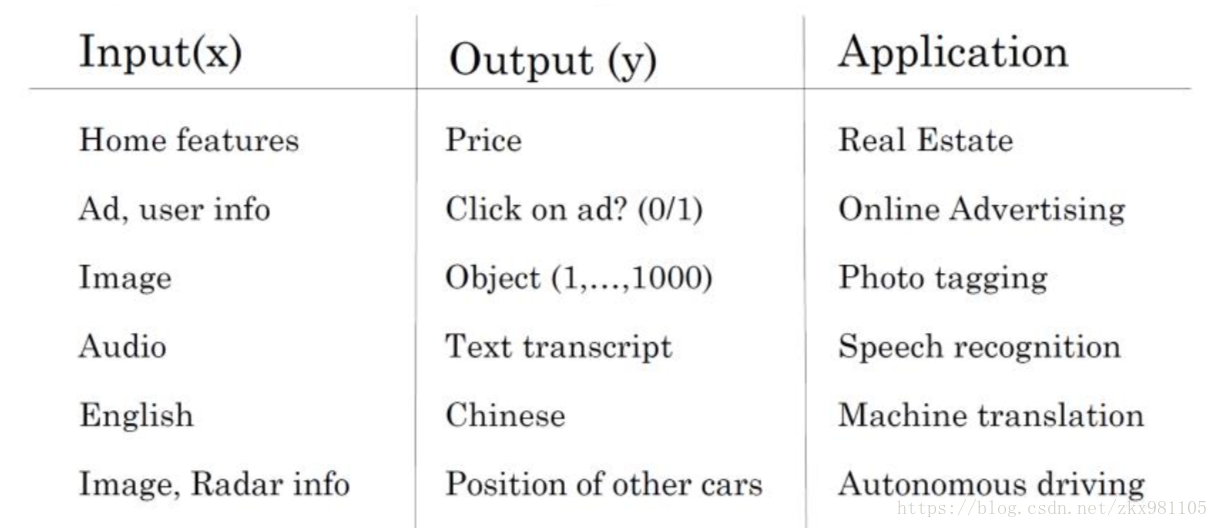
There are several different kinds of neural networks. For example, the Convolution Neural Network (CNN) is often used for image recognition, while the Recurrent Neural Network (RNN) is used for one-dimensional sequence data, such as translating English into Chinese or turning audio into text. For self-driving cars, it’s a hybrid neural network architecture.
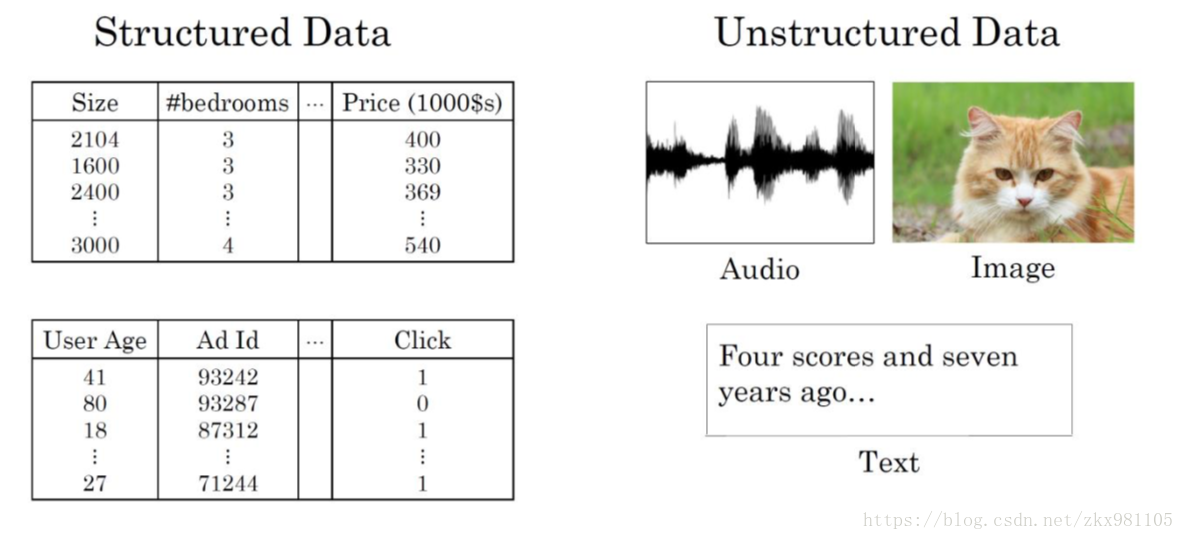
Structured data vs. unstructured data
Structured data means things with numeric definitions, like price and age, while unstructured data means things like pixels, audio, and text.
Comments