This post was translated from the original with AI assistance. Read the original
Reposted from my old CSDN blog: 数据结构 - 线性表 (written 2017-11-18); formatting tidied during migration.
ADT List
Data
	The data object set of the linear list is {a1,a2,......,an}, and every element is of type DataType. Except for the first element a1, every element has exactly one direct predecessor; except for the last element an, every element has exactly one direct successor. The relationship between data elements is one-to-one.
Operation
	InitList(*L) :   Initialization; creates an empty linear list.
	ListEmpty(L) :   Returns true if the linear list is empty, otherwise false.
	ClearList(*L) :    Clears the linear list.
	GetElem(L,i,*e) :  Returns the value of the element at position i in list L via e.
	LocateElem(L,e) :  Searches list L for an element equal to the given value e; if found, returns that element's position in the list to indicate success; otherwise returns 0 to indicate failure.
	ListInsert(*L,i,e)  :    Inserts a new element e at position i in list L.
	ListDelete(*L,i,*e) :    Deletes the element at position i in list L and returns its value via e.
	ListLength(L) :          Returns the number of elements in list L.
endADT
Sequential Storage Structure of a Linear List#
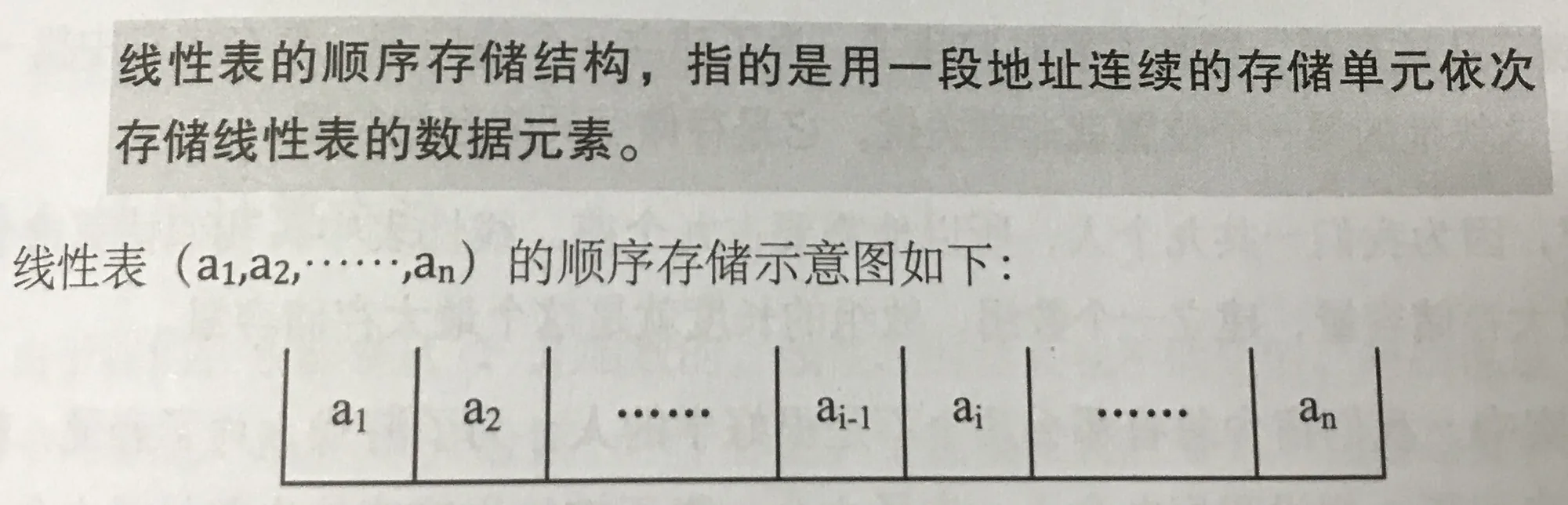
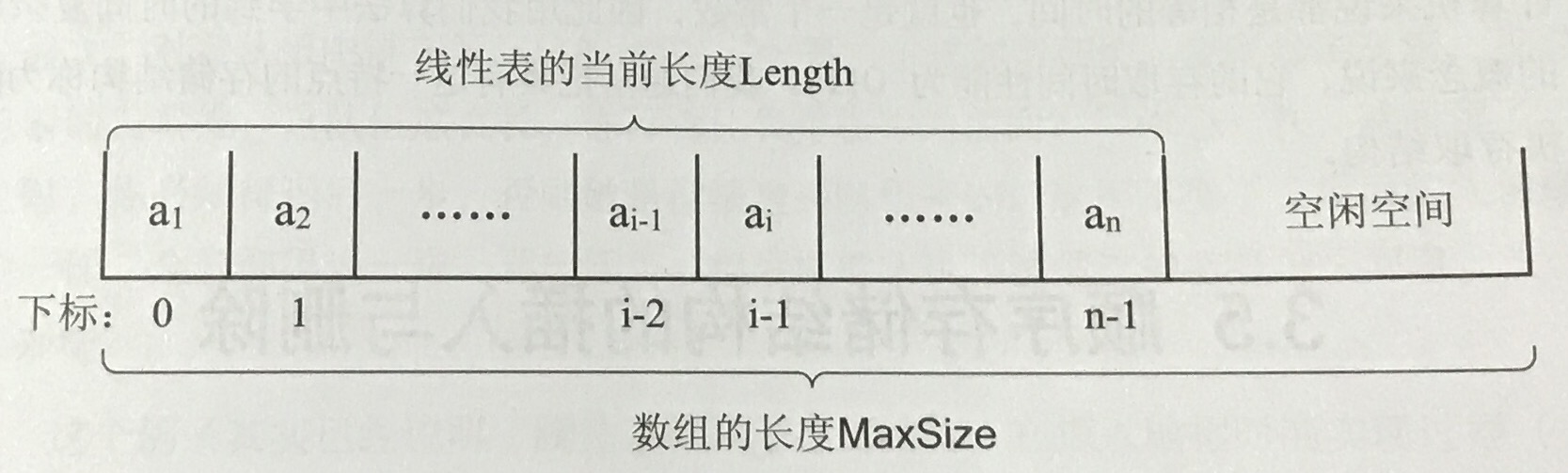
Structure code for sequential storage of a linear list:
#include <stdlib.h>
#define OK 1
#define ERROR 0
#define TRUE 1
#define FALSE 0
#define MAXSIZE 20
					  /*Initial allocation size of the storage space*/
typedef int Status;   /*Status is the function return type; its value is a result status code such as OK*/
typedef int ElemType; /*ElemType depends on the actual situation; here we assume int*/
typedef struct
{
	ElemType data[MAXSIZE]; /*Array storing the data elements, max size MAXSIZE*/
	int length;              /*Current length of the linear list*/
}SqList;
Code for initializing a sequential linear list:
/* Precondition: sequential linear list L does not exist. */
/* Result: creates an empty sequential linear list L. */
Status InitList (SqList *L)
{
    L = (SqList *)malloc(sizeof(SqList));
    if (!L)
    {
	    exit(0);
	    return ERROR;
    }
    L->length = 0;
    return OK;
}
Code for checking whether a sequential linear list is empty:
/* Precondition: sequential linear list L exists.*/
/* Result: returns the result of the check      */
Status ListEmpty (SqList L)
{
    if (L.length == 0)
        return TRUE;
    else
        return FALSE;
}
Code for clearing a sequential linear list:
/* Precondition: sequential linear list L exists.*/
/* Result: resets L to an empty list     */
Status ClearList(SqList *L)
 {
   (*L).length = 0;
   return OK;
 }
Code for getting an element from a sequential linear list:
/* Precondition: sequential linear list L exists, 1<=i<=ListLength(L)*/
/* Result: returns the value of the i-th data element of L via e*/
Status GetElem (SqList L,int i,ElemType *e)
{
	if (L.length==0 || i<1 || i>L.length)
		return ERROR;
	*e = L.data[i-1];
	return OK;
}
Code for finding an element in a sequential linear list:
/* Precondition: sequential linear list L exists.*/
/* Result: if a value equal to e is found, returns its position; otherwise returns 0 for failure*/
Status LocateElem (SqList L,ElemType e)
{
    ElemType k;
    for (k=0;k<L.length;k++)
    {
        if (L.data[k] == e)
        {
	        break;
            return k+1;
        }
    }
    return 0;
}
Code for inserting an element into a sequential linear list:
/* Precondition: sequential linear list L exists, 1<=i<=ListLength(L)*/
/* Result: inserts new data element e before position i in L; L's length increases by 1*/
Status ListInsert (SqList *L,int i,ElemType e)
{
	int k;
	if (L->length==MAXSIZE)   /*The linear list is full*/
		return ERROR;
	if (i<1 || i>L->length+1) /*i is out of range*/
		return ERROR;
	if (i<=L->length)         /*The insert position is not at the end of the list*/
	{
		for (k=L->length-1;k>=i-1;k--)
			L->data[k+1] = L->data[k];
	}
	L->data[i-1] = e;         /*Insert the new element*/
	L->length++;
	return OK;
}
Code for deleting an element from a sequential linear list:
/* Precondition: sequential linear list L exists, 1<=i<=ListLength(L)*/
/* Result: deletes the i-th data element of L and returns its value via e; L's length decreases by 1*/
Status ListDelete(SqList *L,int i,ElemType *e)
{
	int k;
	if (L->length==0)        /*The linear list is empty*/
		return ERROR;
	if (i<1 || i>L->length)  /*Invalid delete position*/
		return ERROR;
	*e = L->data[i-1];
	if (i<L->length)         /*If the deleted position is not the last one*/
	{
		for (k=i;k<L->length;k++) /*Shift the elements after the deleted position forward*/
			L->data[k-1] = L->data[k];
	}
	L->length--;
	return OK;
}
Pros and Cons#
- Pros
- No extra storage space is needed to represent the logical relationships between elements in the list
- Any element at any position in the list can be accessed quickly
- Cons
- Insertion and deletion require moving a large number of elements
- When the length of the linear list varies a lot, it’s hard to decide the storage capacity
- It causes “fragmentation” of the storage space
Linked Storage Structure of a Linear List#
Singly Linked List#
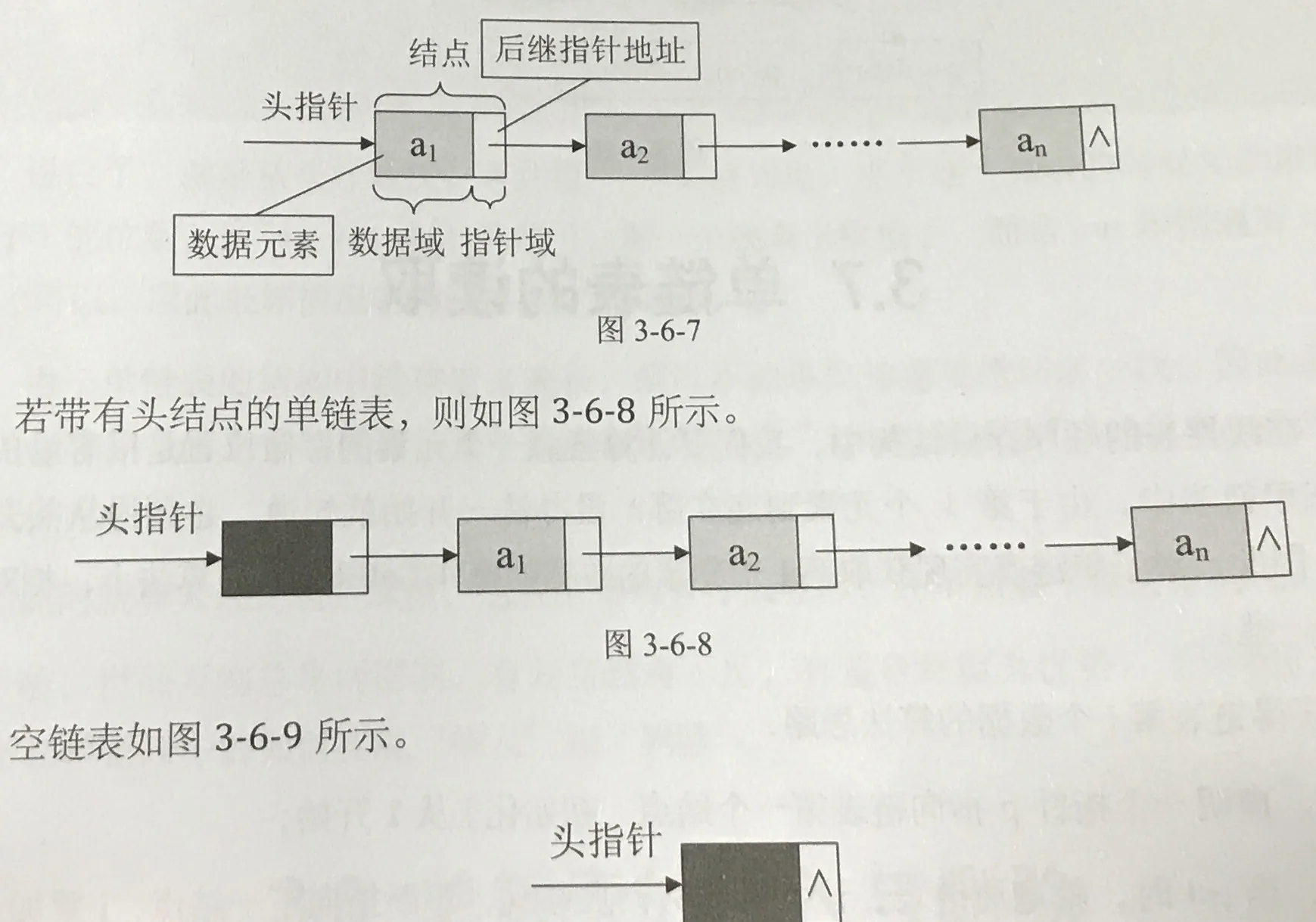
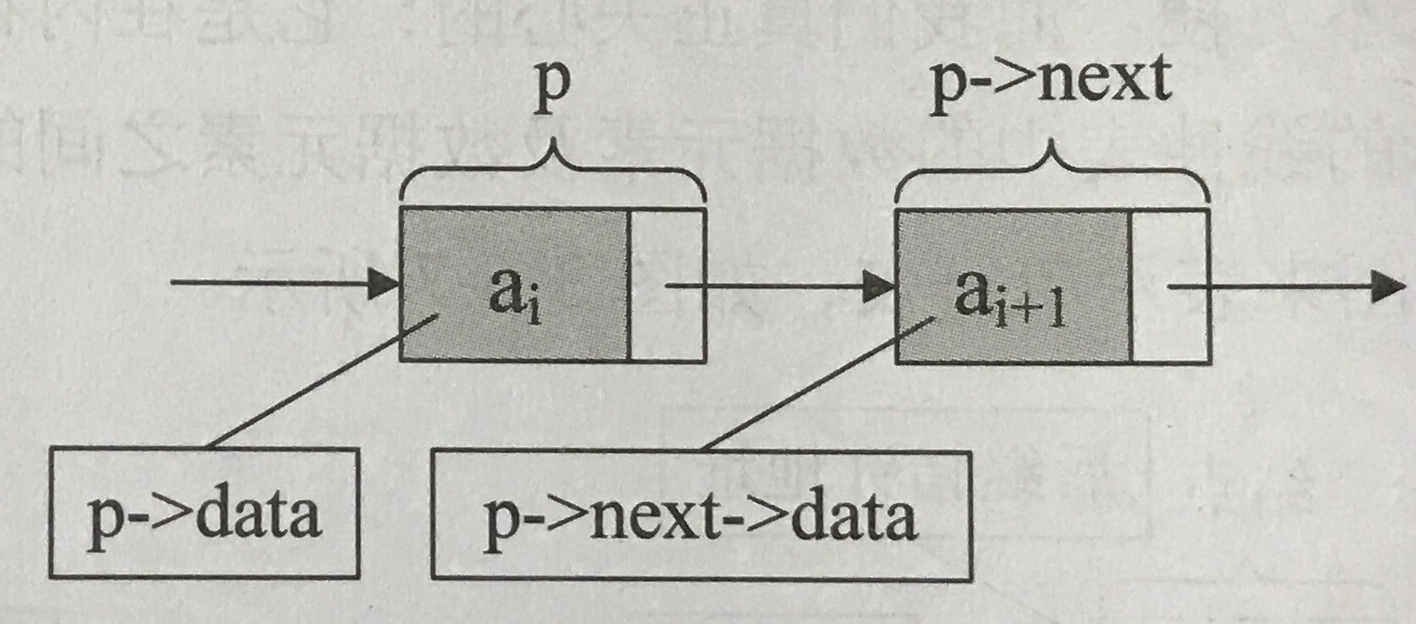
Singly linked list structure of a linear list:
/* Singly linked list storage structure of a linear list */
typedef struct Node
{
    ElemType data;
    struct Node *next;
}Node;
typedef struct Node *LinkList; /* Define LinkList */
Code for reading from a singly linked list:
/* Precondition: singly linked list L exists, 1<=i<=ListLength(L) */
/* Result: returns the value of the i-th data element of L via e */
Status GetElem (LinkList L,int i,ElemType *e)
{
    int j;
    LinkList p;        	/* Declare a pointer p */
    p = L->next;		/* Make p point to the first node of list L */
    j = 1;				/* j is a counter */
    while (p && j<i)
    {
        p = p->next;
        ++j;
    }
    if (!p || j>i)
        return ERROR;
    *e = p->data;
    return OK;
}
Code for inserting into a singly linked list:
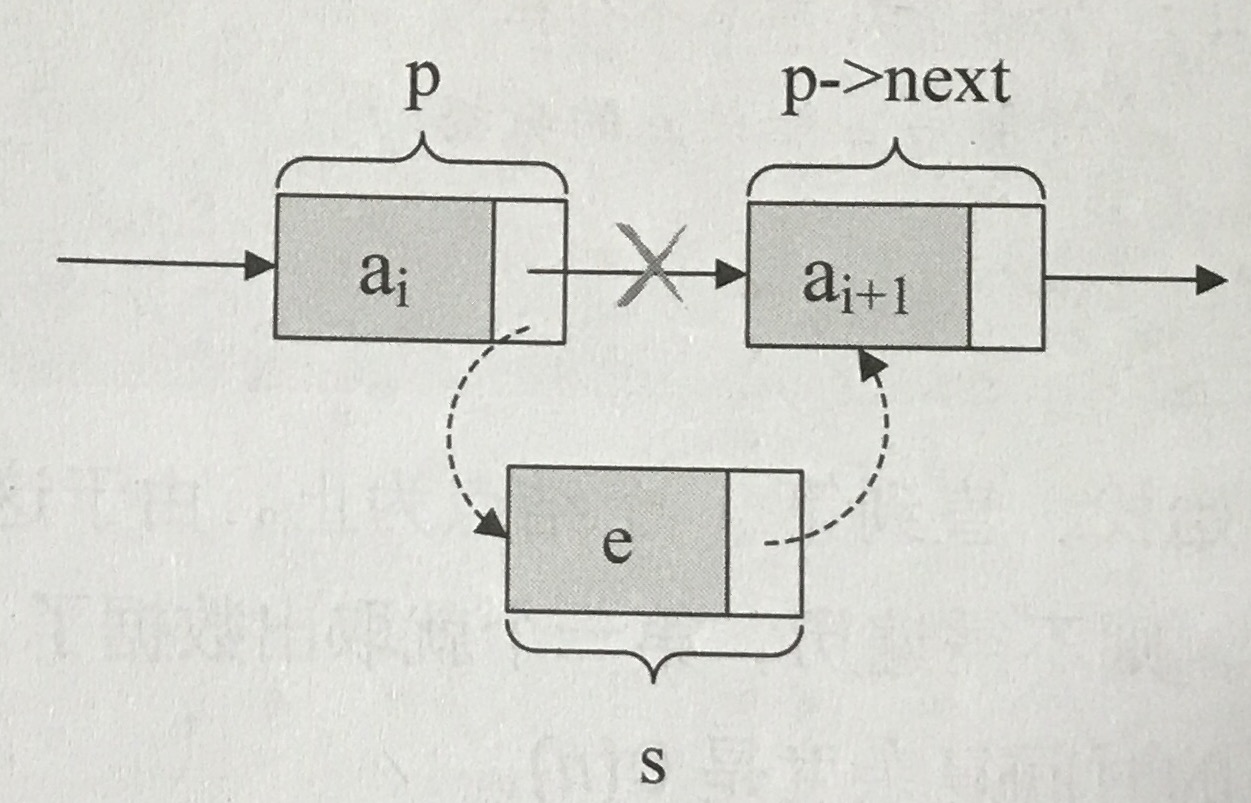
/* Precondition: singly linked list L exists, 1<=i<=ListLength(L) */
/* Result: inserts new data element e before the i-th node in L; L's length increases by 1 */
Status ListInsert (LinkList *L,int i,ElemType e)
{
    int j;
    LinkList p,s;
    j = 1;
    while (p && j<i)
    {
        p = p->next;
        ++j;
    }
    if (!p || j>i)
        return ERROR;
    s = (LinkList)malloc(sizeof(Node));
    s->data = e;				/* Store the new data element in s's data field */
    s->next = p->next;    /* Assign p's successor to s's successor */
    p->next = s;				/* Assign s to p's successor */
    return OK;
}
Code for deleting from a singly linked list:
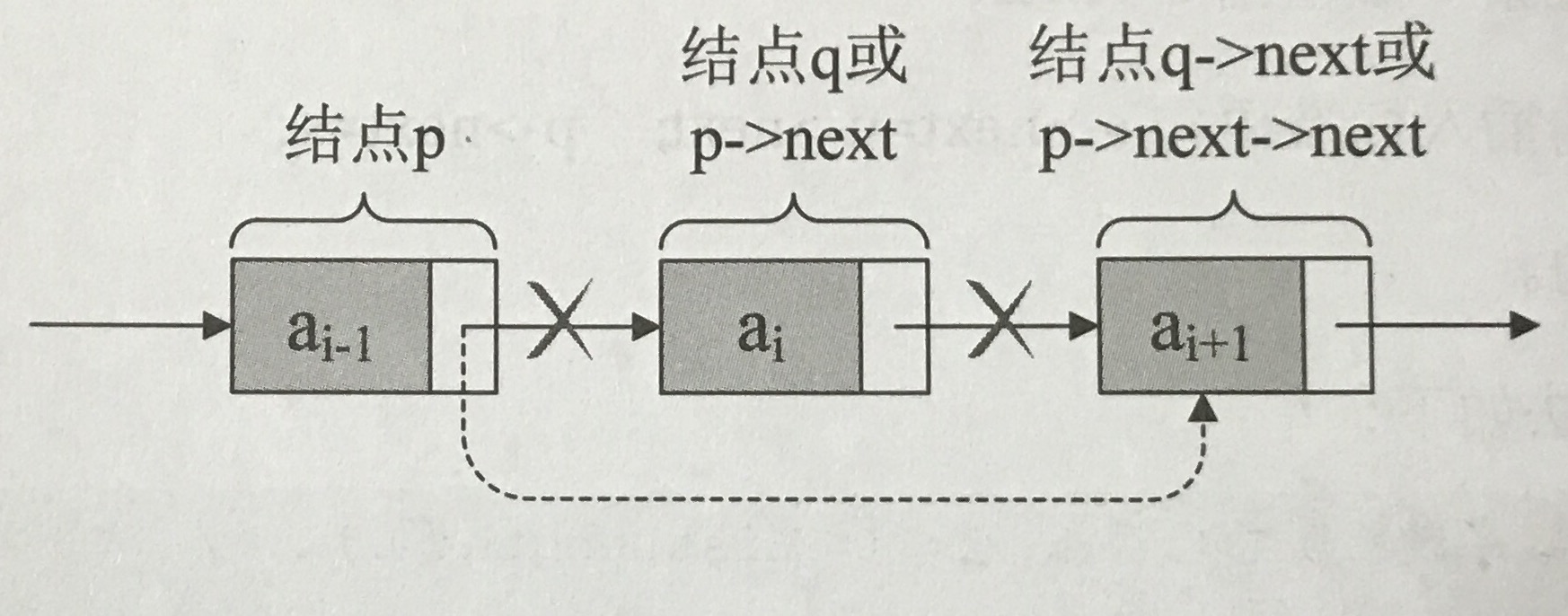
/* Precondition: singly linked list L exists, 1<=i<=ListLength(L) */
/* Result: deletes the i-th node of L and returns its value via e; L's length decreases by 1 */
Status ListDelete (LinkList *L,int i,ElemType *e)
{
    int j;
    LinkList p,q;
    p = *L;
    j = 1;
    while (p && j<i)
    {
        p = p->next;
        ++j;
    }
    if (!p || j>i)
        return ERROR;
    q = p->next;				/* Point q to p's successor */
    p->next = q->next;		/* Assign q's successor to p's successor */
    *e = q->data;			/* Give the data in q to e */
    free(q);					/* Reclaim node q and free its memory */
    return OK;
}
Creating a whole singly linked list:
- Head insertion:
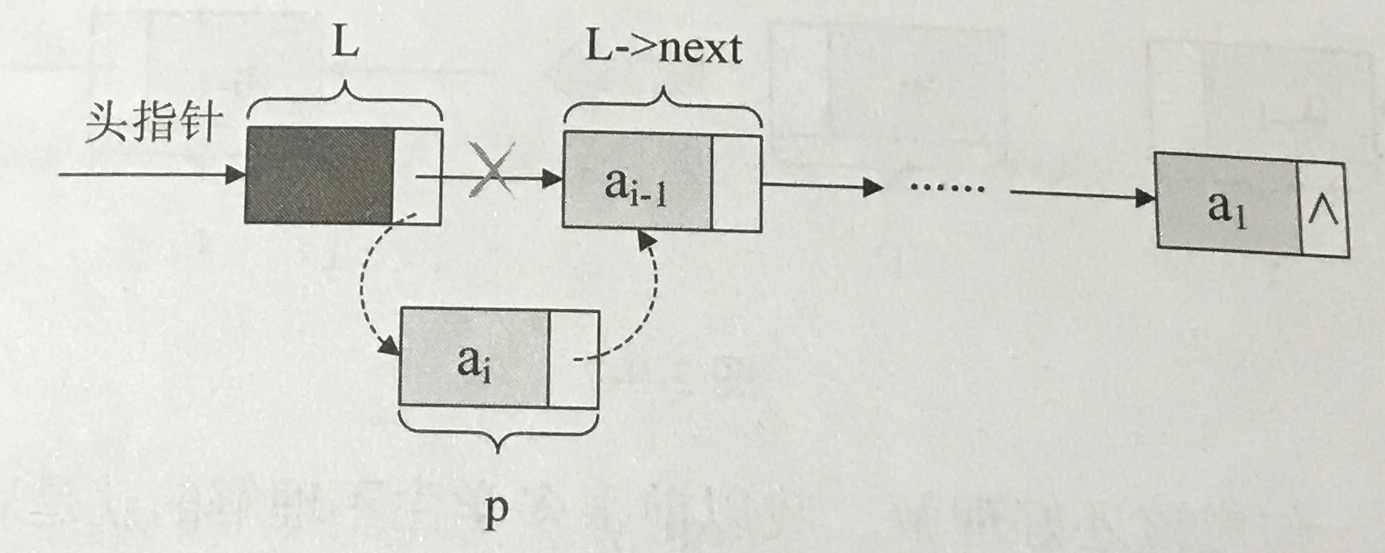
void CreateListHead (LinkList *L,int n)
{
    LinkList *p;
    int i;
    srand(time(0));
    *L = (LinkList)malloc(sizeof(Node));
    (*L)->next = NULL;
    for (i=0;i<n;i++)
    {
        p = (LinkList)malloc(sizeof(Node));
        p->data = rand()%100+1;
        p->next = (*L)->next;
        (*L)->next = p;
    }
}- Tail insertion:
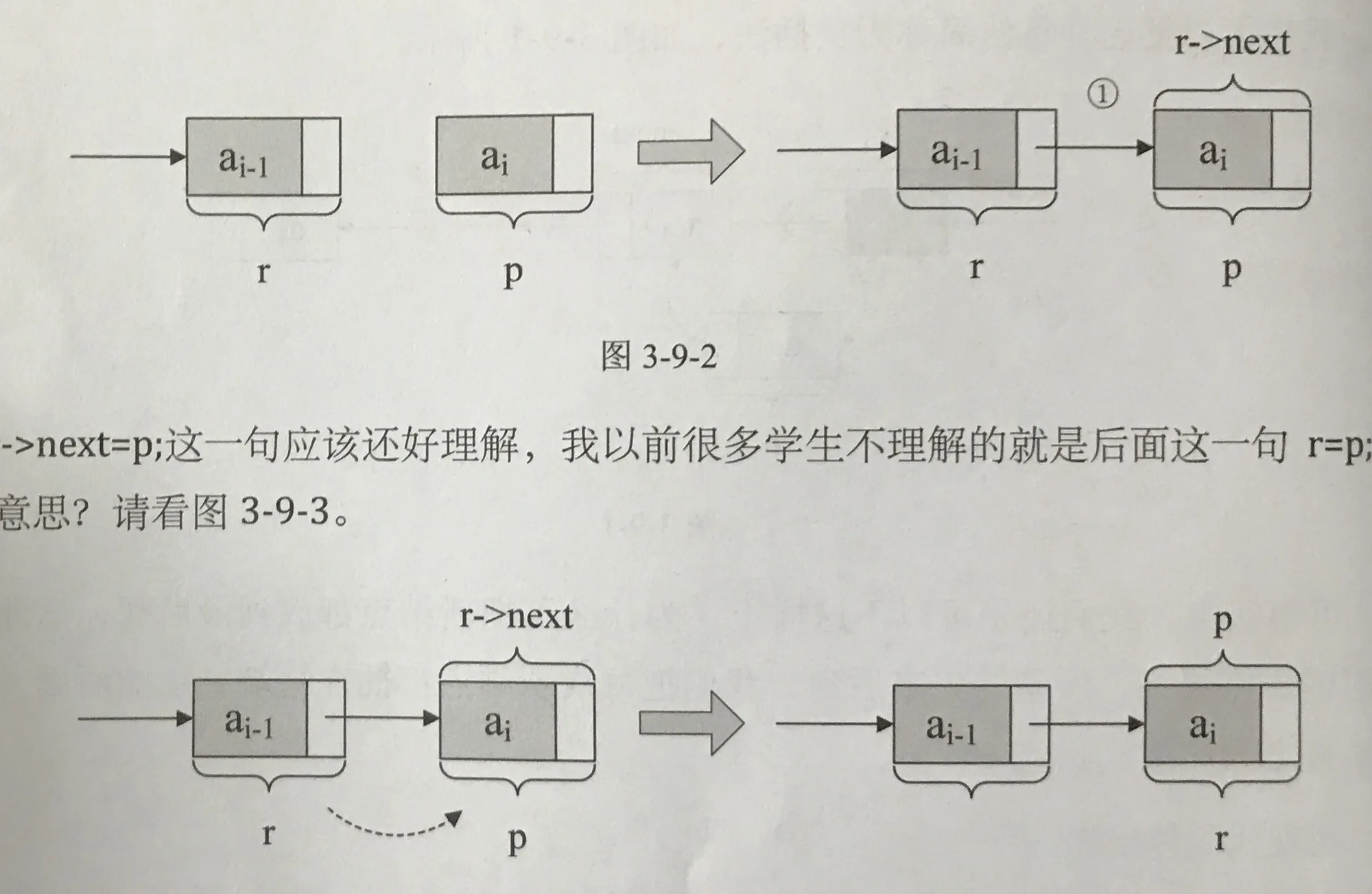
void CreateListTail (LinkList *L,int n)
{
    LinkList p,r;
    int i;
    srand(time(0));
    *L = (LinkList)malloc(sizeof(Node));
    r = *L;
    for (i=0;i<n;i++)
    {
        p = (Node*)malloc(sizeof(Node));
        p->data = rand()%100+1;
        r->next = p;
        r = p;
    }
    r->next = NULL;
}
Deleting a whole singly linked list
Status ClearList (LinkList *L)
{
    LinkList p,q;
    p = (*L)->next;
    while (p)
    {
        q = p->next;
        free(q);
        p = q;
    }
    (*L)->next = NULL;
    return OK;
}
Singly Linked List vs. Sequential Storage Structure#
Storage allocation
The sequential storage structure stores the data elements of the linear list one after another in a contiguous block of storage units
The singly linked list uses a linked storage structure, storing the list’s elements in an arbitrary set of storage units
Time performance
Lookup
Sequential storage structure
Singly linked list
Insertion and deletion
The sequential storage structure has to move, on average, half the list’s elements, so it takes
Once the singly linked list has found the pointer at a given position, insertion and deletion take only
Space performance
The sequential storage structure needs storage space pre-allocated: allocate too much and it’s wasted, allocate too little and it easily overflows
The singly linked list doesn’t need storage pre-allocated; as long as there’s space it can be allocated, and the number of elements isn’t limited either
Static Linked List#
“A linked list described using an array is called a static linked list”: an array of structs stores the data (the data field) and the cursor (Cursor; 0 means it points nowhere) separately.
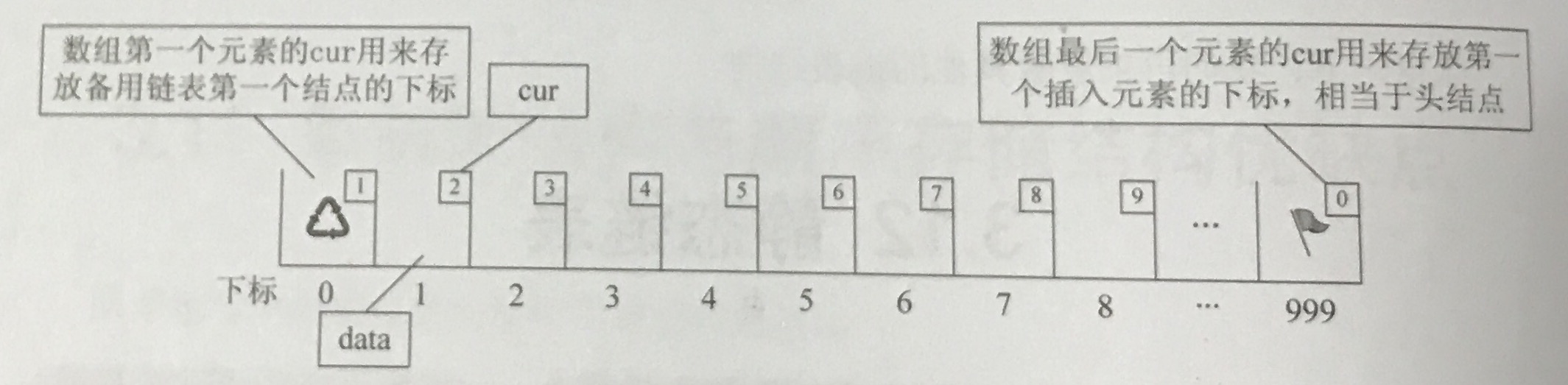
#include <stdio.h>
#include <stdlib.h>

#define MAXSIZE 1000    /* Initial storage allocation size: 1000 */
#define OK 1
#define ERROR 0

typedef int ElemType;		/* Depends on the situation; assume the array stores int */
typedef int Status;

/* Static linked list storage structure of a linear list */
typedef struct
{
    ElemType data;
    int cur;
}Component,StaticLinkList[MAXSIZE];

/* Get the list length */
int ListLength (StaticLinkList L)
{
    int j=0;
    int i=L[MAXSIZE-1].cur;
    while (i)
    {
        i = L[j].cur;
        j++;
    }
    return j;
}

/* Initialization */
/* Link all components of the 1-D array space into a spare list; space[0].cur is the head pointer, and "0" means a null pointer */
Status InitList (StaticLinkList space)
{
    int i;
    for (i=0;i<MAXSIZE-1;i++)
        space[i].cur = i+1;
    space[MAXSIZE-1].cur = 0;			/* The static linked list is currently empty; the last element's cur is 0 */
    return OK;
}

/* Pre-allocate free space */
/* If the spare space list is not empty, return the index of the allocated node; otherwise return 0 */
int Malloc_SLL (StaticLinkList space)
{
    int i = space[0].cur;					/*The index of the first spare free slot to return */

    if (space[0].cur)
        space[0].cur = space[i].cur;		/*Use the next component of the element being taken as the spare */

    return i;
}

/*  Reclaim the free node at index k into the spare list */
void Free_SSL (StaticLinkList space,int k)
{
    space[k].cur = space[0].cur;		/* Assign the first element's cur value to the cur of the component being deleted */
    space[0].cur = k;					/* Assign the index of the component being deleted to the first element's cur */
}

/*  Insert new data element e before the i-th element in L   */
Status ListInsert (StaticLinkList L,int i,ElemType e)
{
    int j,k,l;
    k = MAXSIZE-1;
    if (i<1 || i>ListLength(L)+1)
        return ERROR;
    j = Malloc_SLL(L);        /* Get the index of a free component */
    if (j)
    {
        L[j].data = e;
        for (l=1;l<=i-1;l++)    /* Find the position just before the i-th element */
            k = L[k].cur;
        L[j].cur = L[k].cur;    /* Assign the cur of the element before the i-th one to the new element's cur */
        L[k].cur = j;           /* Assign the new element's index to the cur of the element before the i-th one */
        return OK;
    }
    return ERROR;
}

/* Delete the element at index i */
Status ListDelete (StaticLinkList L,int i)
{
    int j,k;
    if (i<1 || i> ListLength(L))
        return ERROR;
    k = MAXSIZE-1 ;
    for (j=1;j<i-1;j++)
        k = L[k].cur;
    j = L[k].cur;
    L[k].cur = L[j].cur;
    Free_SSL (L,j);
    return OK;
}
Comments